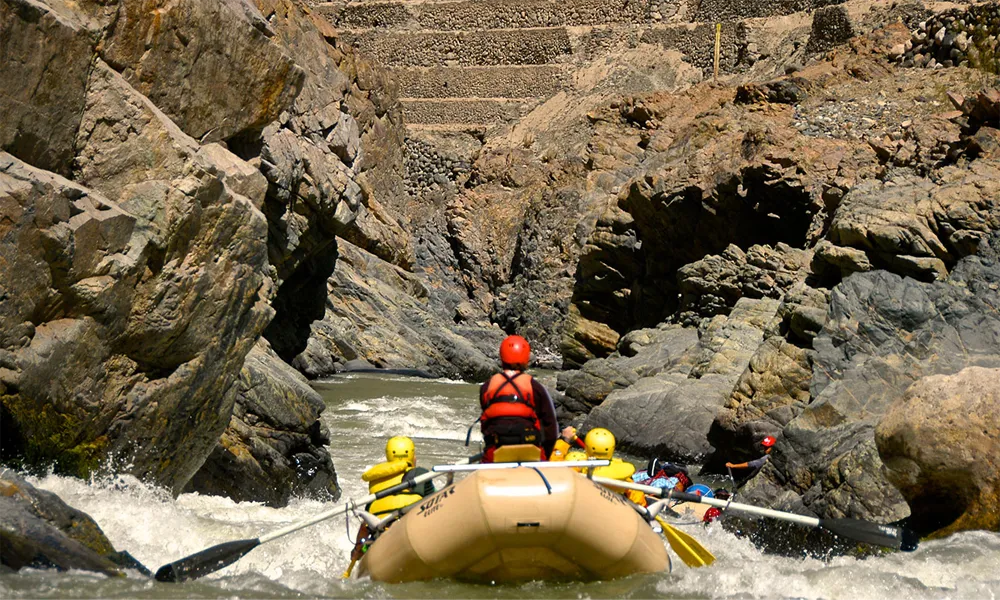
Inca Jungle rafting is usually an optional afternoon activity in the Santa María area, navigating sections of the Vilcanota River/lower Urubamba River. Many agencies offer it as a fun 1-2 hour “extra,” featuring moderate rapids and geared towards travelers with no experience.
1) 📍 Where does it take place and what’s the route like?
The typical route includes:
- Departure/transfer from Santa María to a nearby boarding point (bridge or river access).
- Safety briefing before entering the water.
- Equipment distribution (helmet, life jacket, windbreaker/jacket, etc.).
- Navigation along a section with rapids and calmer areas to recover and practice.
Some agencies describe the experience as rafting on the Vilcanota or lower Urubamba (the warmer section), with a “high jungle/cloud forest” landscape.
2) 🧩 What is the difficulty level? (Classes II–III… and sometimes IV)
Rapids are classified from I to VI (I very easy, VI extreme). For Inka Jungle, the most common classification you’ll see advertised is:
- Class II–III (moderate, ideal for beginners with a guide).
- In some sections/conditions, agencies mention the presence of Class II, III, and IV rapids.
📌 Note: Some operators use “categories” unclearly (for example, they mix “rapid class” with “life jacket category” or even list higher levels). Therefore, it’s advisable to ask which class of rapids (II/III/IV) they will be running that day and whether it depends on the water flow.
3) 🌧️ Season and Water Level: The Biggest Factors in Difficulty
On Andean rivers, the “same route” can feel different depending on:
- Recent rainfall
- Wet vs. dry season
- Sudden rise in water level
Generally, higher water level = more power = more technical difficulty. Even tour guides mention that water levels can rise during the rainy season.
✅ Practical recommendation: If you go during a season with more frequent rains, expect it to feel more intense and that some agencies may cancel or postpone trips for safety reasons.
4) 🛡️ Safety Equipment a Reputable Agency Must Provide
Look for the following to be included, at a minimum:
🪖 Personal Equipment
- Helmet
- Life jacket (correct size and properly fitted)
- Jacket/windbreaker or splash protection (depending on the operator)
Many agencies explicitly list this (helmet, life jacket, and pre-trip briefing).
🛶 Group Equipment
- Raft in good condition
- Appropriate paddles
- Guide(s) to lead the navigation
- In some cases, extra support (safety kayak) — depends on the operator
5) 🧠 The Safety Briefing: What it should include
Before entering the river, it’s essential that they explain and practice the following:
- How to sit and where to hold on (stable position)
- Basic commands (forward, back, stop)
- What to do if:
- you fall into the water (float position, feet up if appropriate, don’t stand up in a strong current)
- the raft capsizes
- Rules: don’t let go of the paddle, don’t “play” outside of instructions, stay focused
If the agency wants to rush you in without a briefing, 🚩 that’s a bad sign.
6) ⚠️ Real Risks (no exaggeration, no lies)
In tourist rafting, the most common incidents are:
- Falling into the water (due to loss of balance or being hit by a wave)
- Minor bumps and bruises (paddle, raft edge)
- Slipping when entering/exiting the river
- Arm/back fatigue from paddling and maintaining posture
What reduces almost all the risk: proper equipment + listening to the guide + not getting overconfident.
7) 👤 Is it suitable for everyone?
It’s usually suitable for beginners, but it’s NOT always ideal if:
- You’re terrified of water (even if you wear a life jacket)
- You have a recent injury (shoulder/back/knee) that worsens with sudden movements
- You don’t feel capable of following quick instructions
Some agencies indicate requirements such as knowing how to swim (this varies by operator and conditions).
8) 🎒 What to Bring (and What NOT to Bring)
✅ Bring
- Clothes that can get wet (or a wetsuit/light clothing as indicated)
- Dry clothes to change into afterward
- Footwear that won’t slip off (old sneakers or adjustable athletic sandals)
- Sunscreen (if it’s sunny)
- Water bottle
❌ Avoid
- Loose cell phone, documents, or money in plain sight
- Sunglasses without a strap
- Items that “if they fall, they’ll be lost”
If you need to bring something, use a waterproof bag and ask if the operator allows it on the raft.
9) ✅ Key Questions to Assess Safety Before Paying (Super Helpful)
- What class of rapids is typically encountered (II/III/IV) and how does this change with rain?
- Is a helmet and life jacket included (and what type/size)?
- Is there a mandatory briefing and command practice?
- How many guides are on each raft? Is there extra support on the river?
- f the river is running high, do they cancel or change sections?
If they answer “no problem, it’s super easy” without details → 🚩
🏁 Conclusion
Inka Jungle rafting is usually a moderate, guided experience, typically Class II–III, with the possibility of feeling more intense (even approaching Class IV) depending on the water level and section. The most important things for safety: complete equipment, a thorough briefing, and a responsible operator.