Inka Jungle Downhill Bike Tour: Route Type, Distance, and Equipment
For many, the Inka Jungle bike stage is the most adrenaline-pumping part of the tour: a long descent from Abra Málaga to warmer areas (Santa María or surrounding areas), passing through several ecological zones in just a few hours.
The important thing to note: it’s not technical downhill like a “bike park.” It’s almost always a descent on roads (mostly paved) with curves, changing weather, and possible traffic, so the challenge lies more in control, braking, and safety than in jumps or narrow trails.
1) 🛣️ Route Type: Where do you ride?
✅ Most common terrain
- Mostly paved roads (sustained descent, curves, and switchbacks).
- Sections with wet asphalt, loose gravel on the edges, and foggy areas depending on the day.
- In some versions, the finish line may be in Huamanmarca (and then a transfer by vehicle) or directly in Santa María.
⚠️ What makes it “challenging”
- Tight curves and high speeds if you get overconfident.
- Constant braking (tires hands/forearms).
- Sudden temperature changes (cold at the top, hot at the bottom).
- Possible presence of other vehicles (it’s a shared route).
📌 Key fact: If there is dense fog in Abra Málaga, some agencies cancel the descent for safety reasons and continue by transport.
2) 📏 Distance: How many kilometers is it really?
The distance varies considerably depending on the operator and the exact starting/ending point. Tour and operator websites show figures like:
- Approximately 43 km (shortest version).
- Approximately 55–56 km (very common in 4D itineraries).
- Approximately 60 km (also very frequent).
- Approximately 65 km (one of the most common figures).
Some descriptions mention 75+ km when considering variations or longer sections.
⏱️ How long does the cycling take?
It depends on the group, stops, and weather, but operators typically report 2 to 4 hours (including breaks for photos and organization).
✅ Practical takeaway: mentally plan for a “half-day” bike ride, but with high concentration.
3) ⛰️ Altitude and climate: why it feels so different
Many tours start near Abra Málaga (approximately 4,300 m) and descend to much lower and warmer areas (Santa María/high jungle).
Some itineraries mention altitude ranges such as approximately 4,350 m maximum and approximately 1,200 m minimum (depending on the exact section).
What does this mean for you?
- Top: cold + wind + possible fog
- Bottom: heat + humidity
- In between: quick changes → the “perfect” clothing at the start might
- be too much 40 minutes later.
4) 🚴♂️ Difficulty level: Who is it for?
You don’t need to be a professional cyclist, but it is advisable to:
- Know how to brake with control (don’t lock up on curves).
- Have basic downhill bike handling skills.
- Be comfortable with curves and moderate speed.
Many agencies market it as “suitable for most” because it’s mostly downhill and guided, but the risks are there if you get overconfident.
5) 🧰 Equipment the agency should provide
On Inca Jungle tours, several agencies indicate that they include:
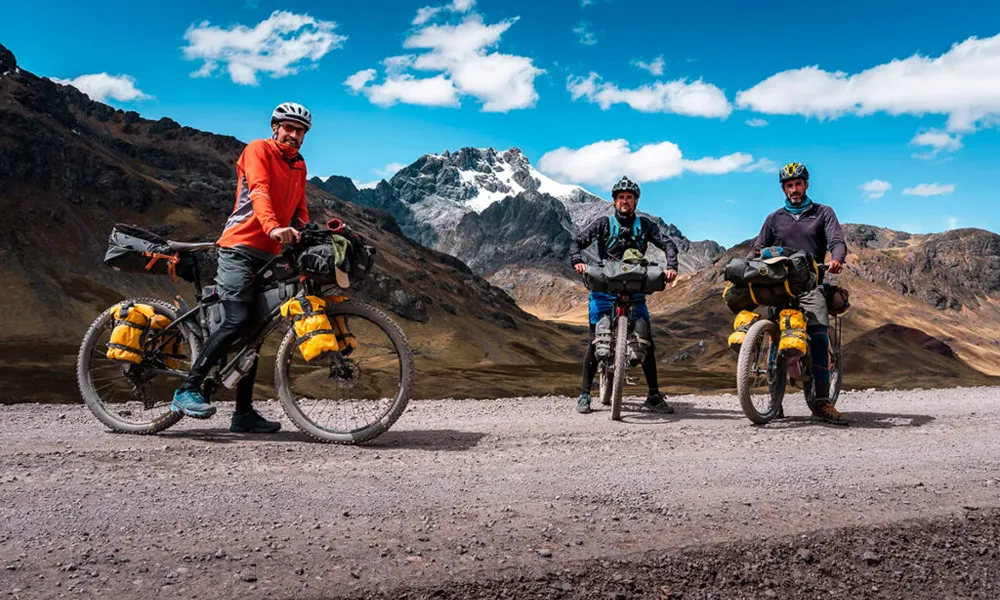
- Mountain bike (sometimes they specify full suspension or brands/models).
- Helmet (ideally a full-face helmet for more “pro” MTB operators, although this varies).
- Knee and elbow pads.
- Gloves and, in some cases, goggles/sunglasses.
- A support vehicle follows the group (in some agencies) for safety or if someone decides not to continue.
🔎 Tip for choosing an operator: ask if the guide is at the front controlling the pace and if there is support behind (this greatly improves safety).
6) 🎒 What you should bring
👕 Layered clothing (key)
- Comfortable base layer (that dries quickly).
- Lightweight windbreaker/waterproof jacket (it can be very cold at the top, and the descent is even colder).
- An extra-thin layer in case the start is icy.
👟 Footwear
- Shoes with good soles (not slippery).
- Avoid bulky shoes if they make pedaling uncomfortable.
🕶️ Protection
- Sunglasses (dust, wind, insects at lower altitudes).
- Sunscreen (it burns at high altitudes even on cloudy days).
💧 Hydration
- Small water bottle or hydration pack.
7) ⚠️ Typical Risks and How to Reduce Them
Most Common Risks
- Fast curves + overconfidence
- Wet asphalt / fog
- Hand fatigue from braking
- Dehydration (because it “doesn’t feel like exercise” but it is)
Best Practices
- Maintain a safe distance from the cyclist in front.
- Slow down to a pace that allows you to brake without panicking.
- In fog: Low speed + maximum attention.
- If you get tired: Let someone know (many agencies offer support).
8) 📌 Mini Checklist Before You Go (Super Useful)
- ✅ Brakes: Do they bite well? No strange squealing?
- ✅ Tires: Are they properly inflated?
- ✅ Helmet: Is it snug and secure?
- ✅ Knee/Elbow Pads: Are they properly positioned?
- ✅ Jacket: Keep it handy (not buried at the bottom)?
The Inca Jungle downhill bike ride is an incredibly fun experience 😄🚵♂️, but its real “challenge” lies in riding smart: downhill road, changeable weather, and curves. The distance usually varies widely (approximately 43–65 km, sometimes more due to variations), so it’s best to be prepared for several hours of focused effort.