Nevado Salkantay
A symbolic journey through history, power, and Andean meaning 🏔️
Nevado Salkantay is not only one of the most imposing mountains in southern Peru. For Andean cultures, it is a major Apu — a living spiritual entity that protects, observes, and balances the territory stretching toward Machu Picchu.
Below, we explore its meaning through five dimensions: geographic, historical, spiritual, symbolic, and contemporary.
I. 🌄 Geographic Dimension: The Dominant Presence
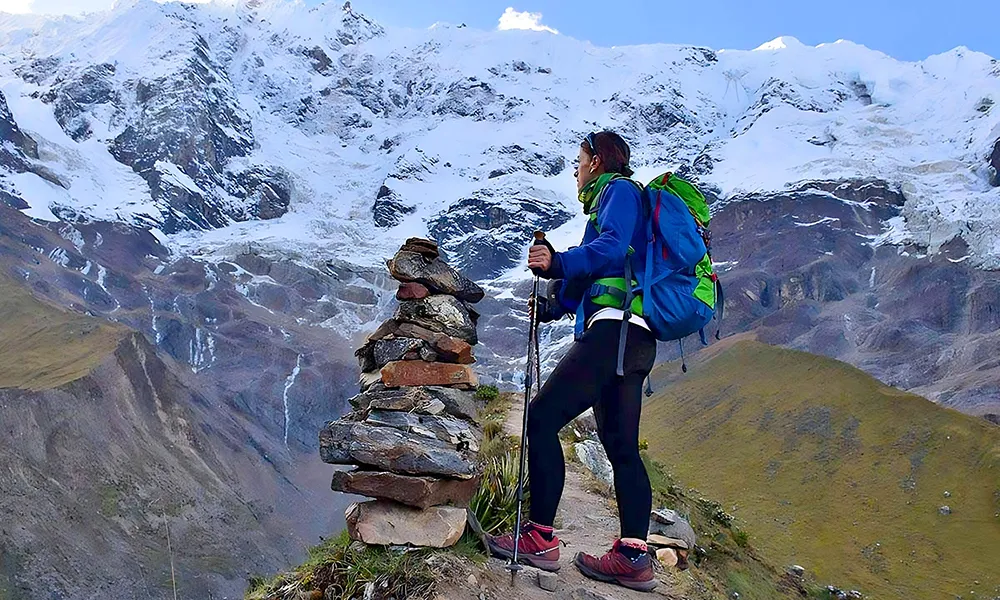
Salkantay rises above 6,000 meters (20,000 ft) in the Vilcabamba range.
It is not a gentle mountain.
>It is not a secondary peak.
It is abrupt, vertical, isolated — visually commanding the landscape.
In the Andes, geography directly shapes spirituality:
the more imposing the mountain, the higher its hierarchy as an Apu.
Its physical character — permanent glacier, steep walls, extreme climate — reinforces its reputation as powerful and untamable.
II. 🏛️ Historical Dimension: The Apu in the Inca World
During the time of the Tahuantinsuyo (Inca Empire), territory was organized not only politically, but spiritually.
Mountains:
- Served as regional protectors
- Defined sacred space
- Sustained agricultural cycles
- Formed part of ceremonial networks
Salkantay belonged to the sacred mountain system surrounding Cusco. Its presence on the horizon was not accidental — it structured the ritual landscape.
Inca architecture did not ignore the environment; it integrated it. Mountains were part of the symbolic design of territory.
III. 🌌 Spiritual Dimension: The Apu as a Living Being
In Andean cosmology, everything possesses vital energy.
Apus are mountains with consciousness and will.
Salkantay is understood as:
- Protector of southern Cusco
- Guardian of rainfall
- Generator of water for the valleys
- Intermediary between the human world and the upper world
The mountain is not worshipped as an object — it is respected as a being.
This respect is expressed through reciprocity rituals: humans give thanks, and the Apu protects.
IV. 💧 Symbolic Dimension: Water, Fertility & Balance
The glacier of Salkantay feeds rivers that nourish agricultural zones.
Symbolically:
- Ice represents purity
- Water represents life
- The mountain represents strength
The fertility of the valleys depends on glacial melt.
Therefore, the Apu is associated with abundance and sustenance.
In Quechua tradition, balance between humans and nature is essential. If balance is broken, the Apu may “weaken.”
V. 🔥 Ritual & Cultural Continuity
To this day, Quechua communities perform:
- Offerings to the Earth (Pachamama)
- Coca leaf ceremonies
- Gratitude rituals
- Protection petitions
These are not archaeological remnants — they are living traditions.
The Apu does not belong to the past. It remains present in Andean spirituality.
VI. ❄️ Contemporary Dimension: Climate Change & Vulnerability
Glacial retreat directly affects Salkantay.
From a scientific perspective:
- Ice mass decreases
- Water patterns shift
- Biodiversity is impacted
From a cultural perspective:
- It is perceived as a sign of imbalance
- It generates spiritual concern
- It reinforces the need for environmental respect
Today, the Apu symbolizes both strength and fragility.
VII. 🥾 The Trekking Experience as Symbolic Encounter
Those who hike the Salkantay Trek often describe:
- A feeling of smallness before the mountain
- Powerful silence
- A particular energy at the pass
- Deep emotional connection
In Andean tradition, that feeling is not accidental — it is an encounter with presence.
Walking toward Salkantay can be interpreted not only as a physical challenge, but as an approach to a mountain carrying ancestral spiritual meaning.
📜 Interpretive Synthesis
| Dimension | Meaning of Salkantay |
|---|---|
| Geographic | Dominant peak with permanent glacier |
| Historical | Part of the Inca sacred mountain system |
| Spiritual | Conscious protective Apu |
| Symbolic | Source of water and fertility |
| Contemporary | Vulnerable ecosystem & cultural heritage |
🏔️ Final Reflection
Nevado Salkantay transcends the purely physical.
It is landscape, history, symbol, and spiritual entity within Andean cosmology.
Understanding its meaning transforms the trek into more than adventure — it becomes a silent dialogue with a presence revered for centuries.
In the Andes, mountains are not just rock and ice.
They are guardians of balance between nature and humanity.