If the Salkantay trek appeals to you but the idea of sleeping in a “rustic” tent doesn’t excite you 😅, glamping in domes is a fantastic alternative: you’re still in the mountains, but with a bed, real warmth, more comfort, and a more “wow” experience (especially at night 🌌).
Note: it doesn’t make the Salkantay trek an easy one. The Salkantay Pass remains challenging. What changes is your rest and your “level of comfort” at the end of the day ✅.
1) What exactly is glamping in Salkantay? 🌄
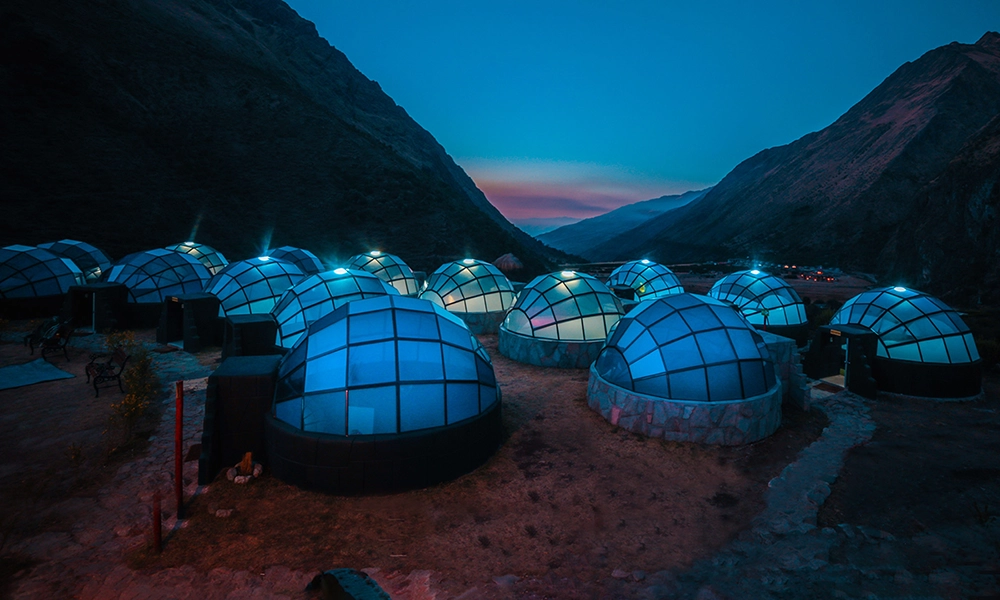
Glamping (glamour + camping) on the Salkantay Trek typically involves:
- Geodesic domes (modern bubble/igloo style)
- Some with transparent panels or large windows for stargazing ✨
- Set up in fixed campsites in strategic locations (not just anywhere)
- With amenities that may include: a bed, lighting, a dining area, upgraded bathrooms, and sometimes showers
📌 Important: not all domes are 100% glass. Many are semi-transparent or have large windows (better for warmth and privacy).
2) Where are the domes located on the Salkantay Trek? 🗺️
On most itineraries, the domes are located in the high/Andean part of the trek, where the scenery is most dramatic:
- Soraypampa area (typical starting point for the trek)
- Near the route to Humantay Lagoon (on itineraries that include it)
- Areas with views of Nevado Salkantay 🏔️
🔎 On common itineraries, the usual setup is:
- 1 night in glamping domes (the “star night” 🌟)
- The rest in basic lodges/hostels or simpler campsites
- Last night almost always in Aguas Calientes (hotel/hostel)
👉 There are “premium” tours that add more nights with a higher standard, but the standard is 1 night glamping.
3) What are the domes like inside? 🛏️
Although it varies by operator, the most common features are:
✅ What’s usually included:
- Real bed (double or twin)
- Mattress + thick blankets
- Sheets and pillows
- Lamp/lighting (sometimes solar)
- Small table or bench
- Insulated floor (wood or platform)
⭐ In more “pro” options:
- Heating or thermal bag (not always)
- Rustic hotel-style decor (blankets, rugs, etc.)
- Larger windows (better nighttime view)
🧠 Realistic expectations:
- It’s not a 5-star hotel. It’s in the mountains.
- But it does feel like “going from a tent to a mini-room” 🔥
4) Are they warm? The truth about the cold 🥶
Many people get confused here because of the marketing.
✅ Yes, a dome tent is usually warmer than a basic tent because:
- it has a more solid structure
- sometimes it has better insulation
- they provide real blankets
⚠️ But at higher altitudes, the cold can be intense. Even with a dome tent, you’ll typically experience:
- cold nights
- windy conditions
- a low wind chill
💡 What helps most:
- sleeping in a thermal layer
- warm socks
- a hat if you get cold easily
- not going to bed in damp (sweaty) clothes 🙅♂️
5) Private bathroom? Hot shower? 🚿🚽 (What to expect and what not to expect)
It depends entirely on the campsite/operator, but in general:
Most common:
- Shared bathrooms (improved vs. traditional camping)
- Basic sink
- Toilet paper may be limited (bring your own just in case 🧻)
In more premium glamping:
- Showers (sometimes with warm/hot water, sometimes “camp-style”)
- Better infrastructure (more organized and clean)
📌 Key tip: even if you have a “shower,” water may be limited.
When trekking, the rule of thumb is: be grateful if it’s available, don’t take it for granted 😄
6) How much does choosing glamping increase the price? 💰
Glamping is usually more expensive because it involves:
- a permanent campsite with infrastructure
- logistics (equipment, maintenance)
- additional services (kitchen, dining tents, etc.)
- 📌 Without giving exact figures (because they vary greatly):
- Traditional camping: more economical
- Glamping: mid-to-high range to premium
The dome isn’t the only important factor: it also depends on whether it includes:
- porters/mules for luggage
- more substantial meals
- a sleeping bag
- a night in a better hotel in Aguas Calientes
- the return train (sometimes included, sometimes not)
7) Real advantages of glamping in Salkantay ✅✨
🛌 You sleep better
Sleeping in a bed and with real warmth changes your mood the next day.
🧠 Less logistical stress
You don’t think so much about “setting up/making it through the night,” but about enjoying yourself.
🌌 Amazing nighttime experience
Starry skies at high altitude = cinematic quality.
👣 Ideal if you want to trek but not in “survival mode”
Perfect for those who want adventure with comfort.
8) Disadvantages or points to consider ⚠️
💸 It’s more expensive
It can significantly increase your total budget.
🏕️ Not absolute privacy
Campsites are shared (noise, schedules, etc.).
🌡️ Weather dictates the weather
If there’s rain/strong wind, you’re still on the mountain.
🚽 Bathrooms aren’t always top-notch
While better than basic, don’t expect urban luxury.
🎟️ Not everything is automatically included
Many believe that glamping = “all-inclusive” (entrance and train).
Not always. You have to check what your package includes.
9) Glamping vs Traditional Camping vs Lodge (Complete Comparison)
| Aspect | Glamping (Domes) | Traditional Camping | Lodge / Hostel on the Route |
|---|---|---|---|
| Bed | Yes ✅ | No (sleeping pad) | Yes ✅ |
| Warmth | High / Medium ✅ | Depends on sleeping bag | Medium ✅ |
| Nature experience | Very high 🌌 | Maximum 🏔️ | Medium |
| Bathrooms | Upgraded shared | Basic | Better (varies) |
| Price | Medium–High 💰 | Low 💸 | Medium |
| Ideal for | Comfort + adventure | “Full-on” adventurers | Those who want a solid roof |
10) Who benefits most from glamping? 👥
✅ Recommended if:
- It’s your first long trek and you want a “safe rest”
- You’re traveling with a partner and want a special experience 💛
- You don’t like sleeping on the ground
- You want to wake up with more energy for the mountain pass
- You’re celebrating something (birthday, special trip)
🤔 Not so necessary if:
- You’re super “outdoor” and love tents
- You’re carrying a sleeping bag and are used to cold camping
- Your priority is saving as much as possible
11) What to pack if you’re going to dome tents (pro list) 🎒✅
Even though there’s a bed, you’re still in the high mountains:
Essential clothing
- Thermal base layer (top/bottom)
- Fleece or light jacket
- Windproof/waterproof jacket
- Hat + gloves
- Extra warm socks 🧦
Useful extras
- Headlamp 🔦
- Sunscreen + sunglasses (strong radiation)
- Wet wipes (just in case there aren’t any) Shower)
- Small toilet paper
- Power bank (charge may be limited)
📌 Tip: “Glamping” doesn’t mean “bring nothing.” It means sleeping better.
12) How to choose a good glamping tour (smart checklist) 🧾
Before paying, check these points (it saves you surprises):
- How many nights in a dome are actually included?
- Is a sleeping bag included or not?
- What meals are included? (breakfast/lunch/dinner/snacks)
- Is luggage carried by mules/porters? (how much weight?)
- Is entrance to Machu Picchu included?
- Is the return train included? (and which station does it arrive at?)
- What are the bathrooms and showers like? (shared, lukewarm water, etc.)
- Is the night in Aguas Calientes in a hotel or hostel?
✨ If an operator is clear about this, it’s usually a good sign.
13) Typical Experience: What a Night in a Dome Is Like 🌌
Imagine this:
You arrive tired, are served a hot drink ☕, settle into your dome, change into dry clothes, lie down on your bed with blankets, and gaze at the sky.
Then you have a hot dinner with your group and return to your dome to the incredible silence of the mountains.
The next day, you wake up to an epic view and a more rested body.
That rest can be the difference between “suffering through the pass” and “enjoying the pass” 😮💨✅
14) Conclusion 🏔️✨
Glamping in domes in Salkantay is one of the best ways to do this trek if you’re looking for adventure without the survival aspect. It doesn’t eliminate the physical exertion, but it greatly improves rest, comfort, and the overall nighttime experience.
If your priority is to enjoy the route with good energy, sleep in a bed in the high mountains and experience an unforgettable night under the stars, then it’s well worth it 🌌🏕️