Inca Tunnels and the Chinkana Beneath Sacsayhuaman: Mystery, Discoveries, and How to Visit Them
Many travelers know that Sacsayhuaman is one of the most impressive Inca constructions, but few are aware of the mysterious underground tunnels and the legendary Chinkana. If this archaeological enigma intrigues you, here you will discover what has been found, whether they can be visited, and what recent excavations have revealed.
What are the Chinkana and the Inca tunnels beneath Sacsayhuaman?
The Chinkana (a Quechua word meaning labyrinth or place where one gets lost) is a system of underground tunnels attributed to the Inca civilization, located beneath the Sacsayhuaman archaeological complex, near Cusco.
According to colonial chroniclers and archaeological studies:
- The tunnels may connect Sacsayhuaman with Qorikancha, the main temple of the Inca Empire.
- They formed part of ceremonial or escape routes used by the Inca elite.
- Some sections were sealed during the colonial period due to accidents and disappearances.
There are two main sections:
Chinkana Grande
- A deeper underground labyrinth that is currently closed to the public for safety reasons.
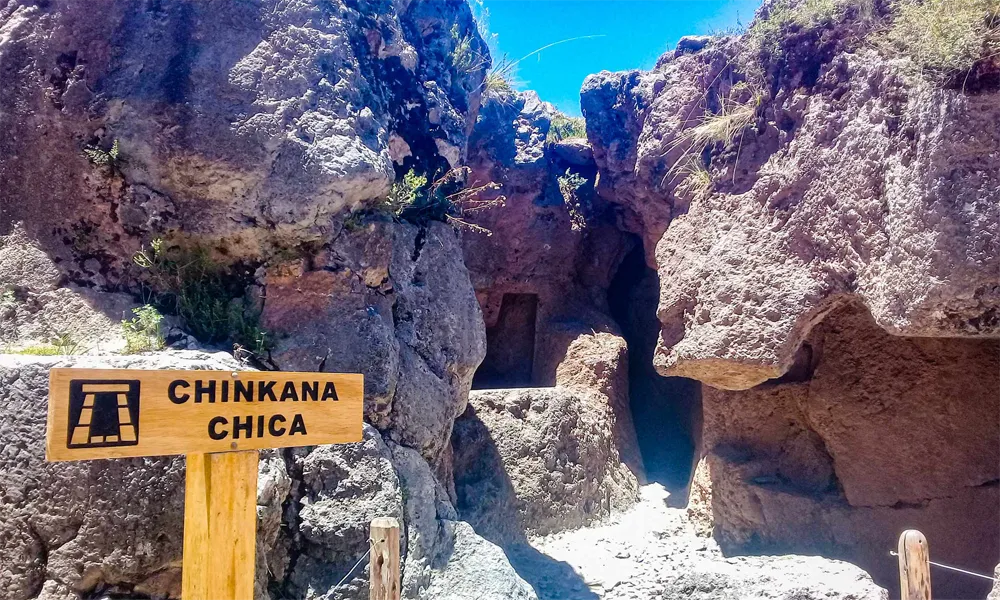
Chinkana Chica
- A small tunnel that can be seen during a visit to the archaeological park, although only partially.
Recent Findings and Excavations
Archaeological investigations and geophysical explorations have revealed important clues:
Radar and ground-penetrating radar surveys
Recent studies detected underground anomalies that suggest the existence of:
- Stone passageways
- Underground cavities
- Possible ceremonial corridors
Some archaeologists believe the system could extend for several kilometers.
Archaeological Findings
During nearby excavations, the following have been found:
- Remains of Inca pottery
- Stone tools
- Sealed underground structures
These findings reinforce the hypothesis that the tunnels were part of a ceremonial and strategic network of Inca Cusco.
Can the Inca tunnels be visited today?
Currently, it is not possible to explore the deep tunnels, but you can explore the surrounding area.
Most visitors experience the history of the Chinkana while touring:
- Sacsayhuamán
- Qenqo
- Puka Pukara
- Tambomachay
These sites are part of the Cusco City Tour.
Quick Table for Tourists
| Aspect | Chinkana Tunnels | Cusco City Tour |
|---|---|---|
| Approximate price | Not directly accessible to visit | 20 – 40 USD |
| Difficulty | Not accessible | Easy |
| Duration | Archaeological exploration | 4 – 5 hours |
| Best time | Dry season (May–October) | All year round |
Costs and what’s included
To visit the Inca tunnels, you must visit Sacsayhuamán as part of the Cusco Tourist Ticket.
Approximate Price
- Partial Tourist Ticket: 70 soles (~18 USD)
- Full Tourist Ticket: 130 soles (~35 USD)
Includes
- Access to Sacsayhuamán
- Access to Qenqo, Puka Pukara, and Tambomachay
- Access to several museums in Cusco
Does not include
- Tour guide (10–15 USD per group)
- Transportation to the site
- Entrance to other sites such as Machu Picchu
Expert Tips for Foreigners (Pro Tips)
1. Prepare for the altitude
Cusco is 3,400 meters above sea level.
Recommendations:
- Rest on the first day
- Drink coca tea
- Avoid alcohol upon arrival
2. Best time to visit
The best times to visit Sacsayhuamán are:
- 8:00 – 10:00 am
- 4:00 – 6:00 pm
There are fewer tourists and better light for photos.
3. Bring sun protection
UV radiation in Cusco is strong even on cloudy days.
Bring:
- Sunscreen
- Hat
- Sunglasses
4. Hire a local guide
Many details about the Chinkana tunnels and Inca legends can only be revealed with a guide.
Guides also explain:
- Theories about the tunnels
- Megalithic architecture
- The ceremonial functions of the site
5. Combine your visit with other sites
You can optimize your day by visiting:
- White Christ Viewpoint
- San Blas Neighborhood
- San Pedro Market
Why does the Chinkana remain a mystery?
Despite centuries of research, the network of tunnels remains one of Peru’s greatest archaeological enigmas.
The reasons:
- Many entrances were sealed during the colonial era.
- Exploration is dangerous due to cave-ins.
- Some areas are protected by heritage regulations.
This keeps alive the legend that a vast Inca underground city might exist beneath Cusco.